
Four numbers that define a cone
Most sourcing problems with speaker cones trace back to a specification that was read too quickly. A cone drawing carries dozens of values, but four of them decide whether the part fits and performs: outer diameter, shape, effective height and centre hole diameter. Get these right and the rest of the conversation is about material and finish.
1. Outer diameter and shape
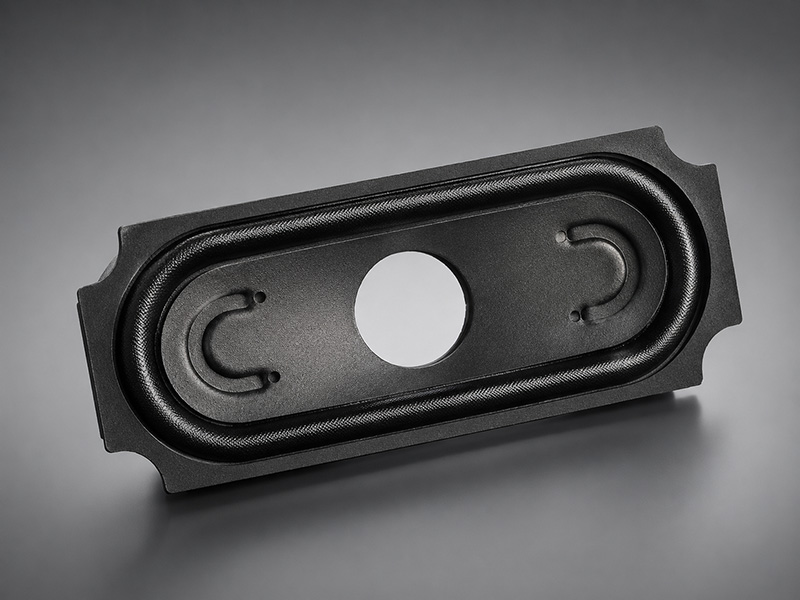
Outer diameter sets the radiating area and, together with the basket, the mounting envelope. Round cones are the default and cover the widest range of applications. Oval and racetrack formats exist for slim enclosures where a round driver physically will not fit — soundbars, compact Bluetooth speakers, TV cabinets and door-mounted automotive positions.
Our catalogue shows how wide that spread can be within a single product family: from Ø50.5 mm on the TY-50-21 up to Ø162 mm on the TY-166-31, plus oval parts such as the TY-5090-14-JA3 at 88 × 48 mm and the long racetrack TY-613-15-JA4 at 117 × 55 mm. A part is never "close enough" here — the cone edge must land on the surround correctly around the whole perimeter, so shape and diameter are confirmed together.
2. Effective height
Effective height is the depth of the cone from its mounting plane to the deepest point. It is not cosmetic. It determines how much space the cone needs before it touches the spider or the motor, how much travel the assembly can use, and how the cavity behind the cone behaves acoustically.
A deeper cone raises stiffness and can push the first breakup higher, generally at the cost of some sensitivity; a shallower cone is lighter and more efficient but easier to flex. This is why two cones with the same diameter are not interchangeable: the TY-34130-09-JA3 at 132 × 35 mm and a flatter 132 mm part will not swap without re-tuning the driver.
3. Centre hole diameter
The centre hole is where the voice coil and former pass through, and it is the dimension most often mismatched. It must clear the coil assembly while keeping the bond line tight and concentric. Too small and the assembly cannot be seated without stress; too large and the adhesive joint loses area, which shows up later as misalignment and rubbing.
In our range centre holes run from Ø14 mm on the compact oval and small round parts up to Ø31.5 mm on the large TY-166-31 and TY-158-31-A. Because the centre hole is cut in the same operation as the cone profile, the correct approach is to quote the voice coil it must match, not just a hole size — we will confirm the tolerance around your coil.
4. Edge type and material
The fourth defining value is the material system: foam, cloth or rubber edge, and the pulp used for the body. This sits on top of the dimensional spec and is covered in detail in our surround selection guide. The practical point for a drawing review is that edge type changes the outer diameter measured over the surround, so the dimension you compare against the basket must state whether it is measured at the cone or over the edge.
Specification checklist before you approve tooling
- Outer diameter — and whether it is measured at the cone body or over the surround
- Shape — round, oval or special, with the full two-axis size for non-round parts
- Effective height, plus the maximum depth available in the enclosure
- Centre hole diameter, quoted together with the matching voice coil
- Edge type and the environment the finished driver will see
- Pulp, colour and surface treatment, if appearance or damping matter
- Packaging and testing requirements for the batch
When you do not have a complete drawing
Many buyers arrive with a sample, a photo, or a target driver rather than a finished drawing. That is workable. We can reverse-engineer the critical dimensions from a physical sample, match against existing standard models first to avoid unnecessary tooling, and only move to a new tool when the standard range genuinely does not cover the requirement.
Confirm your cone specification with us
Tianying Electronics develops, produces and sells electro-acoustic components, with a catalogue of speaker cones spanning round and oval formats in foam, cloth and rubber edge construction. Send us your drawing, sample or photo along with the target application and quantity, and we will confirm dimensions, material and a quotation.