
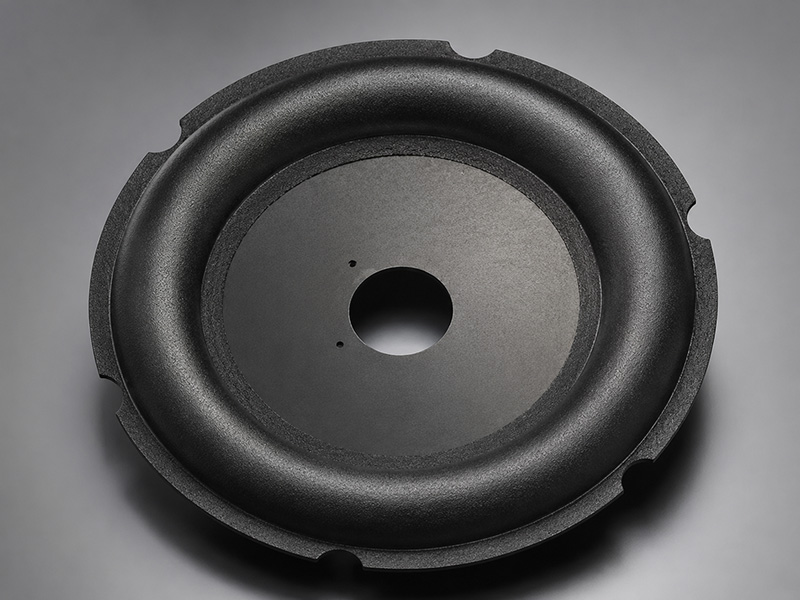
Why the surround decides how a speaker sounds
A speaker cone is only half of the moving assembly. The surround — the ring of material joining the cone edge to the basket — controls how freely the cone can travel, how quickly it stops, and how long the driver keeps working at its original specification. Two cones with identical pulp, diameter and mass will measure and sound different as soon as the edge material changes.
At Tianying Electronics we build paper cones in three edge types: foam, cloth and rubber. All three are produced across round and oval formats, and all three are available with diameter, centre hole, effective height and surface treatment adjusted to your assembly. The sections below explain what each one does best.
The three edge types compared
| Property | Foam edge | Cloth edge | Rubber edge |
|---|---|---|---|
| Typical compliance | High — cone moves easily | Medium | Low to medium — stiffer |
| Damping behaviour | Good internal loss, smooth roll-off | Moderate; can add colouration | High; firm control of excursion |
| Service life in use | Shorter in hot, humid or UV-heavy environments | Long, mechanically tough | Long, resistant to moisture and ageing |
| Power / excursion capability | Moderate | Moderate to high | High — best for large excursion |
| Sensitivity impact | Tends to raise sensitivity | Neutral | Slightly lowers sensitivity |
| Relative cost | Lowest | Low to medium | Highest |
Foam edge: sensitivity and smooth low-frequency roll-off
Foam surrounds are the most compliant of the three, so they let the cone move with very little resistance. That makes them the natural choice for home audio and Hi-Fi designs where you want good low-frequency extension and high sensitivity from a modest motor, and where the cabinet hides the driver from direct sunlight.
In our catalogue this covers a wide spread of sizes — from the compact TY-50-21 (Ø50.5 × 6 × Ø14 mm) up through the TY-135-09A and TY-120-31-A to the large TY-166-31 (Ø162 × 22 × Ø31.5 mm) and the oval TY-713-02A (124 × 73.5 × 18.5 × Ø15.1 mm). The trade-off to plan for is ageing: foam degrades faster under heat, humidity and UV, which is why tropical and automotive buyers often move up to cloth or rubber.
Cloth edge: mechanical durability with a classic midrange character
A cloth surround is impregnated fabric. It tolerates flexing and handling far better than foam, and it holds its properties over a long service life, which is why it remains common in professional audio and in drivers that see regular transport and outdoor use. The damping is moderate, and a cloth edge usually adds a small amount of midrange warmth that many PA and guitar-oriented designs are tuned around.
Our cloth-edge line includes the slim TY-34130-09-JA3 (132 × 35 × 11.5 × Ø14 mm), the long-throw TY-613-15-JA4 (117 × 55 × 13.5 × Ø15 mm), the TY-5090-14-JA3 (88 × 48 × 10.5 × Ø14 mm) and the round TY-100-45-JA4 (Ø99.8 × 18 × Ø26.5 mm).
Rubber edge: control at high excursion and in harsh climates
Rubber surrounds are the stiffest option. That stiffness costs a little sensitivity, but it buys firm control of cone travel, resistance to moisture and ageing, and stable behaviour under high power — the reasons rubber dominates automotive audio, subwoofer and pro sound-reinforcement applications.
Rubber-edge models in our range run from the small TY-3090-03 (88 × 28 × 7 × Ø14 mm) and TY-3090-02 (89 × 29 × 9.5 × Ø14 mm), through the oval TY-4510-10-JA3.5 (98 × 43.5 × 10 × Ø15 mm) and TY-312-05 (118 × 34 × 9.5 × Ø14 mm), to the large round TY-158-31-A (Ø154 × 25 × Ø31.5 mm).
A three-step selection framework
- Start from the application and the environment. Indoor Hi-Fi and bookshelf systems favour foam. Pro audio, touring and long-life fixtures favour cloth. Automotive, marine and high-excursion designs favour rubber.
- Check the acoustic target. If you need maximum sensitivity and low-frequency extension from a small motor, foam is usually the answer. If you need excursion control and power handling, choose rubber. If you need a long service life with a neutral, familiar midrange, choose cloth.
- Confirm the mechanical fit before tooling. Give us outer diameter, shape (round, oval or special), effective height, centre hole diameter and the voice coil it must match. We will match the closest standard model or develop a cone to your drawing or sample.
Where the edge is only part of the decision
Edge material is the largest single variable, but it does not work alone. Pulp grade, cone mass, cone depth and the stiffness of the spider and voice coil all shape the final response. Because we produce cones, voice coils, spiders, dust caps, surrounds, baskets, magnets and crossovers, we can look at the whole moving assembly rather than one part in isolation — which is usually where a specification stops being a guess.
Get samples in your target edge material
Standard models are available for fast selection, and every cone we list can be customised for diameter, material, colour, surface treatment, cone depth, centre hole, packaging and testing requirements. Send us your drawings, samples, photos, target application and quantity and we will come back with a matched proposal and a quotation.
Contact Tianying Electronics Co., Ltd. to request foam, cloth or rubber edge cone samples for evaluation.