
The cone is one part of a system
When a driver underperforms, the cone is often blamed first because it is the part you can see. In practice the cone is one element in a moving assembly whose behaviour is decided collectively. Changing the cone without accounting for the coil, spider and surround usually trades one problem for another.
Tianying Electronics specialises in the R&D, production and sales of electro-acoustic components, and our product portfolio deliberately covers the full set: cones, voice coils, spiders, dust caps, surrounds, baskets, magnets and crossovers. That range is the reason we can talk about the assembly rather than selling cones in isolation.
What each component contributes
| Component | Primary role | What it affects most |
|---|---|---|
| Cone | Radiates sound; provides stiffness with low mass | Sensitivity, frequency response, breakup behaviour |
| Voice coil | Converts electrical signal into motion | Power handling, efficiency, impedance |
| Spider | Centres the coil and provides restoring force | Linear excursion, distortion, mechanical limits |
| Surround | Seals the cone edge and allows travel | Compliance, damping, service life |
| Dust cap | Keeps particles out of the gap; adds stiffness | High-frequency behaviour, reliability |
| Basket | Holds alignment and mounts the driver | Geometry, rigidity, mounting fit |
| Magnet / motor | Provides the magnetic field | Force factor, control, efficiency |
| Crossover | Divides the band between drivers | System integration and balance |
Where mismatches actually show up
Three failure patterns account for most of the problems in a sourcing project:
- Centre hole against voice coil. If the coil has to be forced into the cone, the bond line thins and concentricity suffers. The audible result is rubbing or intermittent noise after a short period of use.
- Cone mass against spider stiffness. A heavier cone with a soft spider loses control at high excursion; a light cone with a stiff spider will not reach the excursion the motor could deliver.
- Surround compliance against the motor. A very compliant surround on a high-force motor wastes travel, while a stiff surround on a modest motor costs low-frequency output.
None of these are visible on a single part drawing. They only appear when the specification is reviewed as a set — which is exactly what our technical matching service is for.
The application decides the emphasis
Different markets pull the design in different directions, and the component priorities shift with them:
- Home audio — bookshelf, home theatre and Hi-Fi: sensitivity and smooth response dominate; foam edges are common.
- Automotive audio — door and rear-deck drivers plus aftermarket upgrades: excursion control and resistance to heat and humidity dominate; rubber edges are common.
- Professional systems — PA, stage and sound reinforcement: durability under sustained power and predictable behaviour dominate.
- Multimedia and Bluetooth speakers — compact enclosures force small diameters and oval formats.
- Consumer electronics — TVs and integrated modules: consistency at volume and clean assembly matter most.
Why sourcing the set together reduces risk
Buying a cone from one supplier, a coil from a second and a spider from a third works, but it moves integration risk onto your own engineering team and makes responsibility for a failure hard to assign. Working with a supplier that produces the components as a set gives you:
- One specification conversation instead of three, with dimensions checked against each other rather than in isolation.
- Material matching — adhesives, pulp and coil wire chosen to work together rather than merely to meet individual datasheets.
- Fewer interfaces to manage at incoming inspection, and a shorter path to the root cause if something does go wrong.
- A cleaner route to custom development, since a change in one component can be evaluated against the rest of the assembly before tooling is committed.
Manufacturing and quality behind the parts
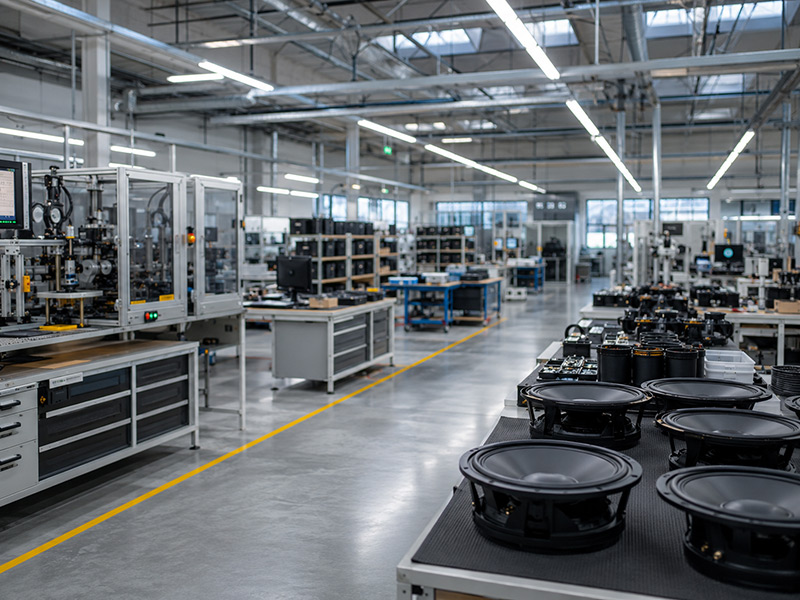
Components are only as reliable as the process that produced them. Our production runs under controlled conditions with raw material checking, in-process control and finished product inspection, and standard models are available for fast selection while customisation covers diameter, material, colour, surface treatment, cone depth, centre hole, packaging and testing requirements.
Talk to us about your moving assembly
Whether you need a standard paper cone, a matched set of electro-acoustic components, or a custom part developed from a drawing or sample, send us your requirement and target quantity. We will propose the closest match from our catalogue and, where needed, develop to your specification.